Elenchus
It doesn’t say what is true or false, it says what holds up and what doesn’t.
From the Greek elenchos (examination, refutation), the name of Socrates’ method of inquiry. And now also the name of a new tool developed by yours truly and AI, which you can reach here on the web for a quick try, and there as a Google Chrome extension for fuller use1.
This tool is something of a logical follow-on to several initiatives tied to what I have been doing these past months around AI and writing, and to my interest in how the brain and language work. If what I write in my newsletter is written without AI, in the sense that every word is mine, that does not mean AI plays no part. I use it first for proofreading (I have an immemorial tendency to let careless mistakes slip into my texts; dictation was never my strong suit). I also use it to check a number of things of substance, notably to avoid unfounded quotations (non-existent or misattributed), and to assess the quality of the reasoning and logic of my texts. It hardly becomes me, indeed, to use bad arguments, at least in writing (the charm of a spoken debate lying in an irrefragable bad faith, at least when little is at stake).
It is a commonplace today to say that we live in an age saturated with information and discourse, marked by the erosion of a number of traditional hierarchies, which makes it harder for everyone to sort true from false. Now, I find that the quality of an argument is a good touchstone for a discourse. There is hardly a bijection here: a truth can sometimes be defended with very bad arguments, and a lie be backed by excellent reasoning, as far as logic goes. Still, a discourse that contains many a fallacy deserves at the very least some scepticism, especially if it presents itself as an argument meant to convince. My intuition is that the closer an idea is to being true, the more it should be able to stand on good arguments. A claim I shall immediately excuse myself from supporting any further, by way of a magnificent and no less ironic appeal to authority: I say so, trust me.
So, among the potential sources of error that could impair our good judgement are the biases of our brain, and fallacious arguments. That is where Elenchus comes in. It is not a tool that will tell you whether something is true or false; rather, it tries to identify what in a discourse is well argued and what isn’t.
Charity beginning at home, I naturally tested my tool on one of my own articles, namely the one devoted to secularism. Clearly the tool has no respect for its maker, since it considers the reasoning set out to be weak…
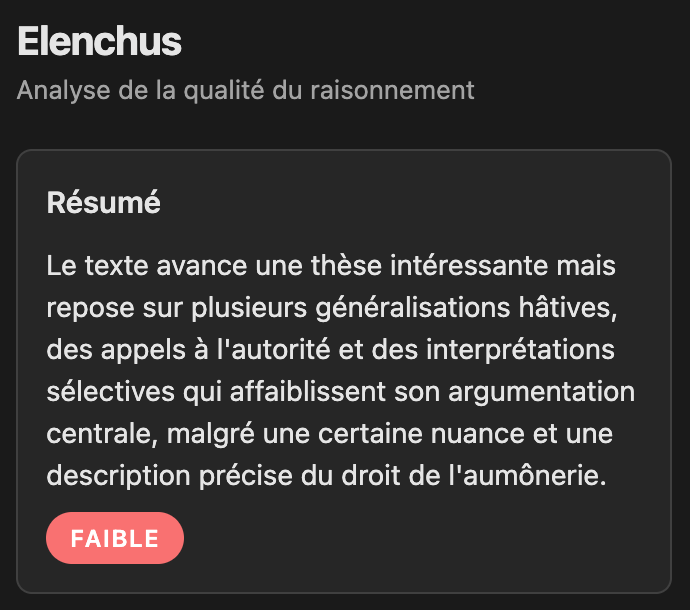
Magnanimous, it does grant me some strengths.
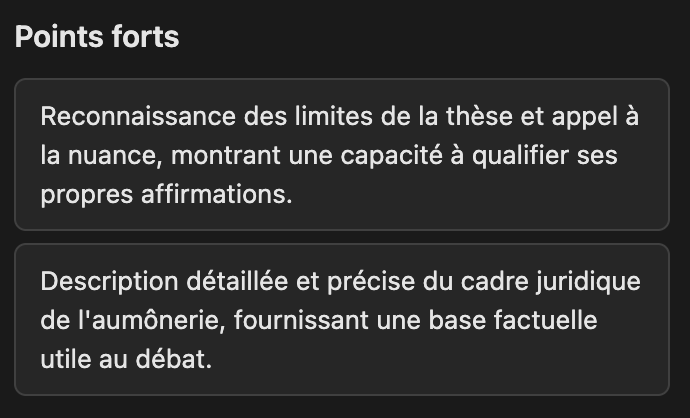
Have I created a tool in my own image, merciless? Will this tool, like Frankenstein’s monster, escape me, to the point of sending my work back to the drawing board twenty times over?
In any case I hope it can be of use to a few, bearing in mind that it is a tool, an aid, in short, a means, and not an end. And I will be very happy to receive any feedback that helps me improve it!
This piece first appeared, in French, in my newsletter.
Footnotes
-
It is my very first one, and I am not a little proud of it, even though I would have preferred to make it a Safari extension, but that would have cost me more; I will invest if success comes my way. ↩
Elenchus read this story
Reasoning weak
Le texte présente une réflexion personnelle sur un outil d'analyse logique, mais son raisonnement est affaibli par des contradictions internes et des arguments non étayés.
What it flags — Circular reasoning Affirmation que je vais immédiatement me dispenser d’étayer plus avant par un magnifique et non moins ironique argument d’autorité : c’est moi qui le dis, faites-moi confiance.
L'auteur utilise un argument d'autorité pour justifier une affirmation qu'il refuse explicitement d'étayer, ce qui annule toute tentative de raisonnement logique. Cela rend l'argument circulaire et auto-référentiel.